Calculation and validation
This page shows what the program calculates, which standards and methods it is based on, and how the calculation has been checked. We are just as clear about what is not included.
The numbers
Facts, not slogans
Everything below comes from the program’s documentation and test suite as of 24 November 2026.
-
31bands
Third-octave bands in every calculation
Direct sound from 20 Hz to 20 kHz, with directivity evaluated across the whole band and air absorption according to ISO 9613-1.
-
1,394models
Loudspeakers from 33 manufacturers
Searchable database of data sheet values from the manufacturers’ own pages, with source and date for every model.
-
430tests
Automated tests, 0 failures
The engine, import, room acoustics, STI, objects, wave simulation and project files are checked against formulas, hand calculations and published references.
-
< 0.1s
Calculation time for a map
3,456 points × 24 loudspeakers × 31 bands on a Mac with Apple M5. The map updates while you move the loudspeakers.
-
61materials
Absorption data with sources
Every absorption value has a stated source. Reverberation time is calculated per octave by Sabine, Eyring and Arau-Puchades.
-
8standards
In calculation and import
Including ISO 9613-1 and -2, IEC 60268-16:2020, ISO 3382-1 and IEC 61672-1. See the table further down.
The calculation engine
What the program calculates
The map is direct sound from each loudspeaker. Room acoustics are added statistically. Every option can be turned on and off under Project → Calculation.
- Direct sound in 31 third-octave bands from 20 Hz to 20 kHz, with frequency response, EQ, delay and polarity
- Directivity evaluated at every frequency sample in the band, not only at the centre frequency
- Coherent, energetic or coherent within groups, for line arrays and cardioid subwoofers
- Shadowing from walls, obstacles and 3D surfaces, with diffraction over one free edge
- Reverberation time per octave by Sabine, Eyring and Arau-Puchades, with Schroeder frequency and critical distance
- Diffuse field (Hopkins–Stryker) and maps for direct + diffuse field
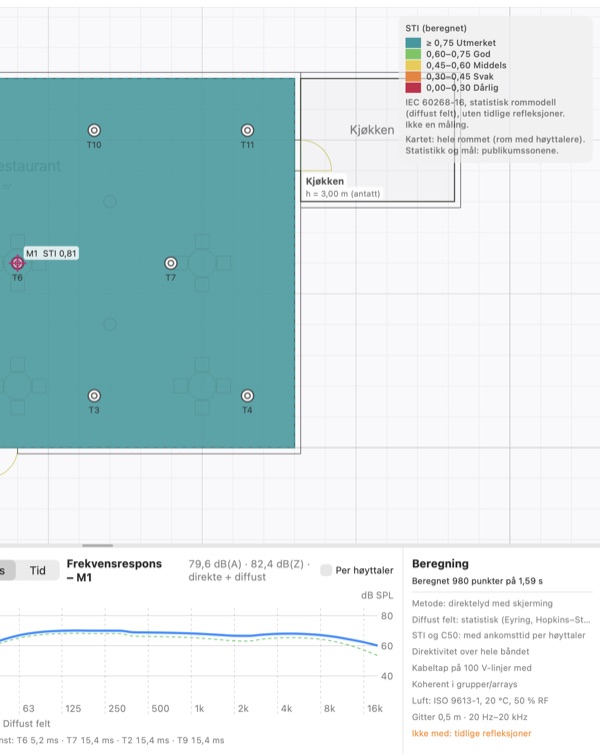
- STI with masking, hearing threshold, speech spectrum and arrival time per loudspeaker
- C50, C80, D50 and centre time Ts per zone, and maps for C50, C80, D50, Ts, %ALcons, D/R and S/N
- Columns, furniture and objects with materials: their surfaces are included in the absorption with direction, their volume is subtracted, and they shadow over the top and around the sides
- Material per wall, and vertical sections with the engine’s values at every point
- Sound waves: a wave simulation of the whole room in 3D (FDTD) with reflections from floor, ceiling, walls and objects, also under tables and between rows of pews, plus the direct sound at one frequency and a fast 2D simulation in one section
- 100 V lines with load, amplifier capacity and cable loss included in the levels
- Level per octave and headroom to max SPL per loudspeaker and zone
| Standard or method | Used for | Status |
|---|---|---|
| ISO 9613-1 | Air absorption | Checked against table values |
| ISO 9613-2 | Shadowing with diffraction (Maekawa), also around the sides of objects | Checked against hand-calculated values |
| IEC 60268-16:2020 | STI, indirect method | Checked against published reference values |
| ISO 3382-1 | Definitions of C50, C80, D50 and Ts | Applied to a statistical energy impulse response |
| Sabine, Eyring, Arau-Puchades | Reverberation time per octave | Checked against formulas and worked examples |
| IEC 61260-1 | Third-octave and octave bands | Implemented |
| IEC 61672-1 | A and C weighting | Checked against table |
| ISO 11654 | Absorption class and αw | Implemented |
| AES69 (SOFA) | Import of measured directivity | Implemented |
| FDTD (Yee grid, PML) | Wave simulation in 3D and 2D | Checked against exact solutions |
Validation
Checked against reference values, openly documented
A selection of the reference cases in the test suite. Each test has a fixed criterion, and all 430 tests pass.
| Reference case | Criterion | Result |
|---|---|---|
| Point source in free field, 1–32 m | L = S + 10·log P − 20·log r, ±0.01 dB | Passed |
| Air absorption, 6 climates × 8 octaves | ISO 9613-1, within the rounding of the table | Passed |
| Two identical sources | Coherent +6.02 dB, energetic +3.01 dB, ±0.01 dB | Passed |
| Line array, 8 elements, far field | +20·log 8 coherent, ±0.1 dB | Passed |
| Baffled piston | −6.02 dB at ka·sin θ = 2.215, ±0.05 dB | Passed |
| Sabine, published worked example (15 × 20 × 4 m) | ≈ 0.56 s, ±0.006 s | 0.5552 s |
| Eyring, same room, hand-calculated | 0.4362 s, ±0.001 s | 0.4362 s |
| Arau-Puchades, uneven absorption, hand-calculated | 0.8455 s, ±0.000001 s | Passed |
| STI, published reference point (AIJ A-21) | 0.311, ±0.001 | 0.3109 |
| Shadowing, Maekawa per ISO 9613-2, hand-calculated | ±0.0001 dB per octave | Passed |
| Shadowing against Kurze and Anderson (1971) | Within 1 dB | Largest deviation 0.67 dB |
| C80 in a purely diffuse field, T = 2 s | −1.3206 dB, ±0.000001 dB | Passed |
| Room 10 × 8 × 3 m with column, stage, table and row of seats, hand-calculated | Surfaces, volume and absorption per octave as hand-calculated | Passed |
| Square column 0.4 m between source and receiver | Two paths around the sides: 1.933 / 2.979 / 5.368 dB at 125 Hz / 1 kHz / 4 kHz, ±0.002 dB | Passed |
| Wave simulation: eigenfrequencies in a hard room | The first 8, ±0.5 % | Largest deviation 0.040 % |
| Wave simulation: reflection at normal incidence | √(1 − α), ±0.03 | Largest deviation 0.0046 |
| Wave simulation: reciprocity A→B against B→A | ±0.0001 | 6.4 · 10⁻⁷ |
| 3D wave simulation: the first 10 eigenfrequencies in a hard room | ±0.5 % | Largest deviation 0.164 % |
| 3D wave simulation: source above a hard floor against the exact image-source solution | ±1 dB | Largest deviation 0.27 dB |
Honest about what is calculated
The program shows what is and is not included in the calculation, both in the analysis panel and in every report.
- The map shows direct sound in free field, with shadowing from walls and obstacles when it is turned on.
- Room acoustics are statistical (Sabine, Eyring, Arau-Puchades and diffuse field). Early reflections are not calculated, so C50, C80 and D50 are conservative estimates.
- STI is a calculated estimate with a statistical room model and should be checked by measurement before it is used as documentation.
- The engine is validated against formulas, hand calculations and published references, not against measurements in rooms or against other programs. We therefore do not claim that it is more accurate than other programs.
- In the wave simulation the sources radiate equally in all directions (directivity is included in the maps and the section), the audience is not modelled as cells, and air absorption is not included. It is checked against exact solutions, not against measurements.
- Furniture in imported 3D models shadows the sound but is not included in the reverberation. Draw it as objects to include its surfaces.
- The program gives no approval of voice alarm, fire alarm, electrical installations or rigging.
- The built-in loudspeaker models are generic planning models and are clearly labelled as such.